How we read nonprofit videos with AI
We follow 158 nonprofit YouTube channels and 27 podcasts. Now an AI model reads every transcript and answers five questions: who speaks, what about, why, how, and what they ask you to do. Plus the fundraising signals and the feelings behind them.
· 5 min read
Emails show how nonprofits ask in writing. Video is where they ask with a face: a director talking to the camera, a mother in a clinic, a volunteer at a food bank. Giving Radar follows the YouTube channels of 158 organizations and 27 podcasts about the sector, more than 100,000 videos and 7,000 podcast episodes so far. Nobody can watch that. So, as we did with emails and news, we now let an AI model read the videos first and describe them in a fixed way. This post explains exactly how.
01 - What we collect
- Every public detail of every video, from YouTube itself: title, description, length, views, likes, and the top comments. This is plain code, no AI, and the whole history of each channel.
- The transcript: what is said in the video, from YouTube's captions. For now we fetch them for the newest videos first.
- A short English summary when the video isn't in English. The transcripts so far are in English, Spanish, Korean, Arabic and Ukrainian.
- The signals: one AI call per video with a transcript. The rest of this post is about that step.
A video without a transcript isn't classified. Guessing what a video says from its title alone would make the numbers look more solid than they are.
02 - Five questions for every video
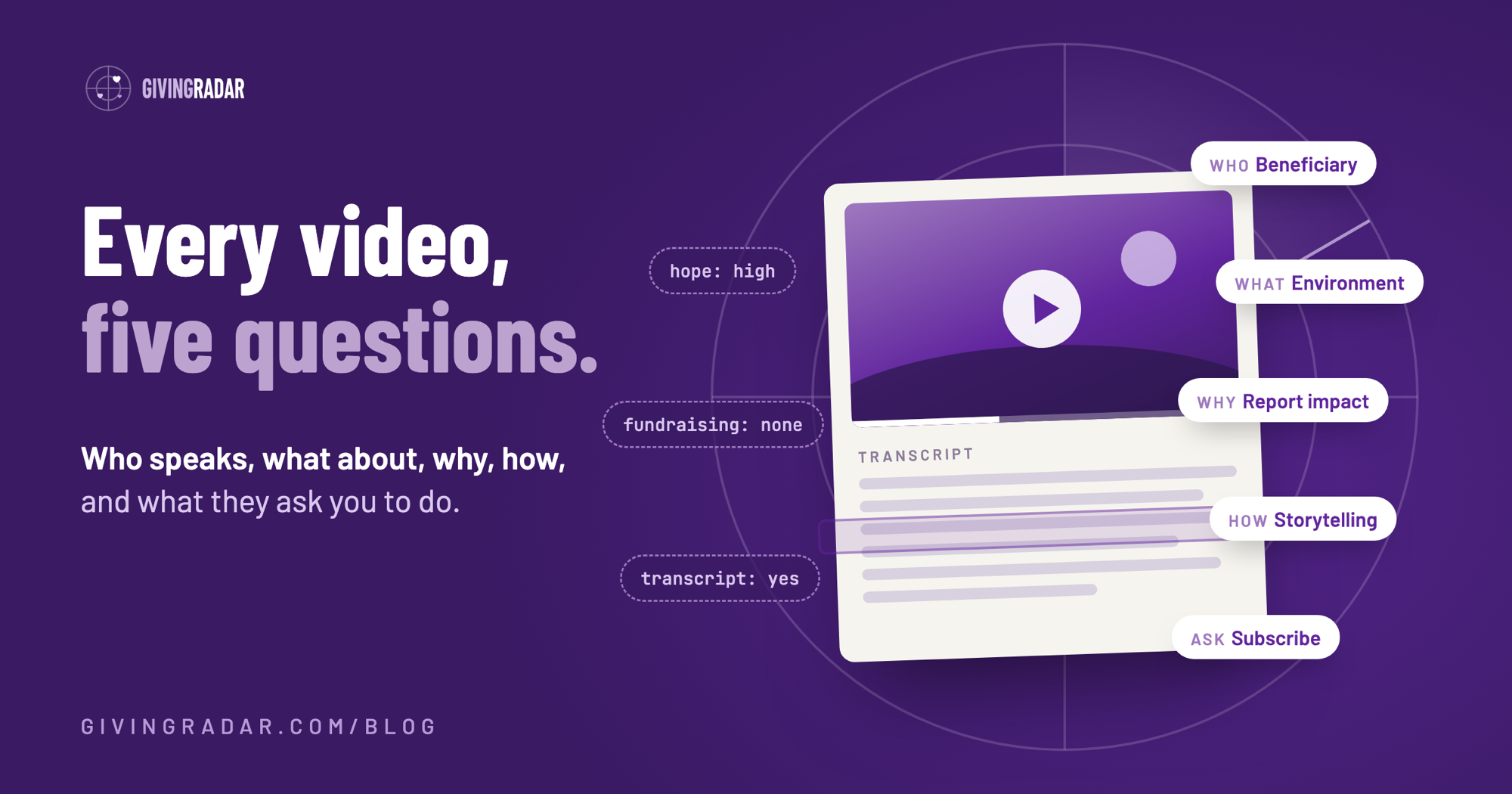
The AI gets the title, the description and the full transcript, in whatever language it was spoken, and answers in English. The heart of it is five questions:
| Question | Allowed answers | |
|---|---|---|
| WHO | Who speaks or appears? | director, staff member, volunteer, beneficiary, donor, celebrity, influencer, expert, narrator |
| WHAT | What is it about? | 1 to 3 of the same 23 topics we use for news: health, education, animals, human rights, fundraising... |
| WHY | What is the video for? | raise awareness, generate a donation, recruit volunteers, advocacy, thank donors, report impact, promote an event, education |
| HOW | How is it told? | storytelling, interview, statistics, testimonial, documentary, animation, speech, event footage, behind the scenes |
| ASK | What does it ask you to do? | donate, volunteer, share, subscribe, attend, sign, join, buy, fundraise, advocate, learn more, follow |
A video can have more than one answer to each: a director and a beneficiary can both speak, and a video can raise awareness and ask for money. An empty answer means "not there": a video with no ask has an empty ASK, and that's a finding too.
The same topics as the news on purpose: it lets us put the two side by side. When the news talks about a crisis, do the videos follow?
03 - Fundraising and marketing signals
Two more lists go one level deeper than the ASK.
Fundraising signals say how a video asks for money, when it does:
- a donation request, one-time or recurring
- monthly giving
- an emergency appeal
- a matching gift ("every dollar doubled")
- a major donor ask
- peer-to-peer fundraising (asking you to raise money from your friends)
- a named campaign
Marketing signals say how the video tries to get your attention:
- storytelling, and especially a beneficiary's story, told by or about one person who was helped
- statistics
- a celebrity or an influencer
- a testimonial
- an event
- a seasonal campaign (year end, Giving Tuesday) or an awareness day
The difference matters. "Donate" tells us a video asks for money. The signals tell us which kind of ask it is, and which tools it uses to make it land. That's where the patterns are.
04 - Emotions, without fake precision
The AI also notes which feelings a video appeals to, from nine: hope, urgency, fear, empathy, anger, joy, gratitude, inspiration and solidarity. For each one it says low, medium or high, and leaves out any that are barely there.
We don't ask for scores like 0.73. A model asked for decimals gives different decimals each time it reads the same video; three levels are something it can answer the same way twice, and something a person can check.
05 - One video, read
Here is the first video the system read: a seven-minute film from WWF Germany about cocoa farms that bring wildlife back to Colombia's Amazon.
| The AI's answer | |
|---|---|
| WHO | a staff member, a beneficiary, a narrator |
| WHAT | climate and environment |
| WHY | raise awareness, report impact |
| HOW | storytelling, documentary |
| ASK | subscribe |
| Fundraising signals | none |
| Marketing signals | storytelling, beneficiary story |
| Emotions | hope: high, inspiration: high, empathy: medium, solidarity: medium |
That reads true to the video: a hopeful impact story, told with the farming families, that asks for nothing more than a subscription.
06 - The rules that keep it honest
- Fixed lists only. Every answer must come from its list, spelled exactly. Anything else is dropped before it's saved. Labels can't be invented or misspelled, so videos can be counted and compared.
- "Other" is allowed, and it teaches us. When no topic fits, the AI may propose a new one. The suggestions that keep coming back become new topics. The lists will grow, maybe to a hundred topics or more.
- Versioned lists. Every change to the lists gets a new version number, and videos read with an older version are read again.
- The transcript decides. The model is told to judge from what is actually said, not to guess, and that automatic captions can have mistakes.
- Every call is logged, failed ones too.
07 - Trends are counted, not asked
There's a sixth question we never ask the AI: what is changing? One video can't tell you that. Trends come from counting the answers month by month, across organizations, countries and causes.
The first report we want from it: Nonprofit CTA Trends. Of all the videos this month, how many ask you to donate, to share, to volunteer, to sign? Is "learn more" replacing "donate"? Are matching gifts spreading from email into video? Every number in it will come from counting saved answers, with no new AI calls.
08 - Which model we use
We use Gemini 3.5 Flash-Lite, a small, fast model from Google, through Eden AI, the same setup as for news. We can switch models from our admin without changing code.
09 - What we haven't done yet
This is the start, not the results. Today 61 videos and podcast episodes have transcripts, and the first ones are being read now. Before we publish a single number from them:
- We will check the AI by hand. We'll watch about 30 videos ourselves, compare with its answers, and fix the lists or the instructions where it's wrong, as we did with 200 emails.
- We will fetch more transcripts, so the counts mean something.
- Then the first CTA Trends report.
As always, the AI reads and labels. People decide what it means and what gets published.