How we read nonprofit podcasts with AI
We follow 27 podcasts about the nonprofit sector. An AI model reads every transcript and pulls out what the people in it think, predict, recommend and learned, each with the exact words they used as proof.
· 7 min read
In videos, nonprofits talk to donors. In podcasts, they talk to each other. A fundraiser explains what went wrong with a TV campaign, a CEO admits the team is exhausted, a consultant says the feasibility study is broken. It's the sector thinking out loud, and it's where you hear what people worry about months before it shows up in an appeal.
Giving Radar follows 27 of these podcasts on YouTube, from The Nonprofit Show and Nonprofit Nation to All About Capital Campaigns and The Fundraising AI Podcast: more than 7,000 episodes so far. A full episode runs from a quarter of an hour to well over an hour, so nobody can listen to all of it. This post explains how an AI model reads them for us, and why we read podcasts differently from every other source.
01 - Why podcasts get their own reading
For emails and videos, the main question is: how does this ask for money? A podcast rarely asks for anything. It's a conversation about the work. Asking "what's the call to action?" of a 40-minute interview about board governance gives a useless answer.
So podcasts don't get the five video questions. They get two other things:
- Labels, from fixed lists, so episodes can be counted: what it's about, and which problems come up.
- Statements: the most telling things people say, each one sorted by kind and backed by a quote.
As always, only episodes with a transcript are read. The transcript comes from YouTube's captions; when an episode isn't in English, the AI reads it in its own language and answers in English.
02 - Labels: topics and problems
Topics are the same 23 we use for news and videos (fundraising, nonprofit management, technology and AI, health...), 1 to 4 per episode. The same list everywhere means podcasts, videos and news can be put side by side.
Problems are a list of their own: the difficulties nonprofits talk about.
| Area | Problems on the list |
|---|---|
| Money | declining donations, funding uncertainty, government funding cuts, donor acquisition cost |
| Donors | donor churn, donor stewardship, fear of asking, trust, audience engagement |
| People | staff burnout, staff turnover, volunteer shortage, leadership challenges, board governance |
| Work | rising demand, lack of resources, siloed teams and channels |
| Tools | technology adoption, data quality, measuring impact |
When nothing fits, the AI answers "other" and suggests a name. That's how the list has already grown once: after the first episodes, the problems the AI kept suggesting were added to the list, and every episode was read again with the new one.
03 - Statements: seven kinds of things people say
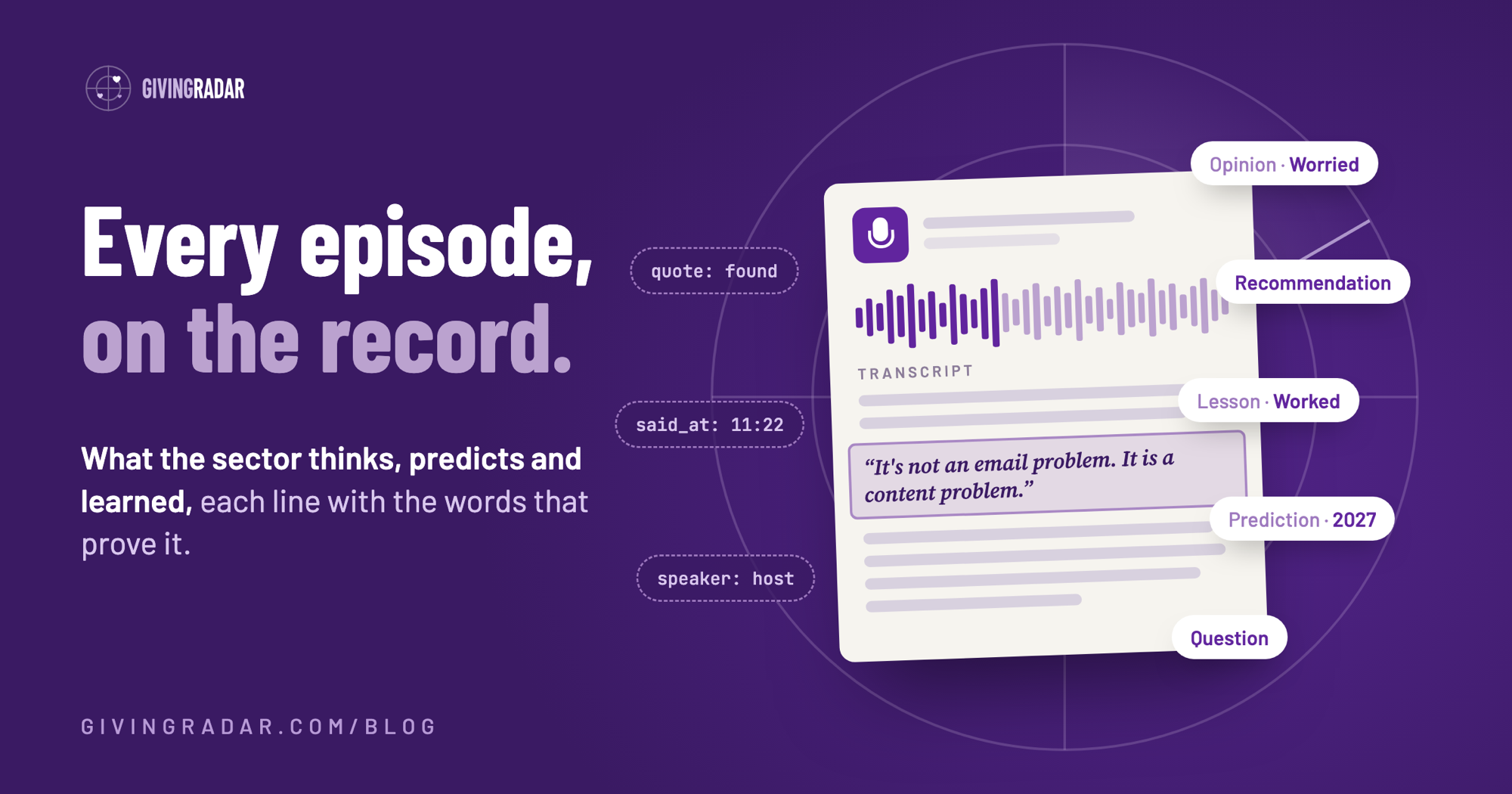
This is the heart of it. The AI picks out what people actually say and sorts each statement into one of seven kinds:
| Kind | What it is | Extra detail |
|---|---|---|
| Opinion | what someone thinks, or worries about | the tone: positive, worried or neutral |
| Prediction | what someone expects to happen | the year it's about, when said |
| Recommendation | what someone tells nonprofits to do | |
| Lesson | something tried, and how it went | the outcome: worked, failed or mixed |
| Action | something an organization did | which organization |
| Plan | something an organization intends to do | which organization |
| Question | a question the sector is asking itself |
Each statement is one plain sentence that stands on its own, with its topic, who said it and the organization it's about. At most five of each kind per episode, the most telling ones: more than that and the AI starts padding with small talk.
A worry is simply an opinion with a worried tone. Our first plan kept "beliefs", "concerns" and "experiences" apart, but in a real conversation even people can't reliably tell them apart, so we merged them.
04 - Every statement comes with proof
A summary can sound right and be wrong. So every statement must come with a quote: 4 to 15 words copied exactly from the transcript, never from the episode's description.
Then code, not AI, checks it. We search the transcript for the quote. When it's there, we save the second it's said, and the admin links straight to that moment in the episode. When it isn't there, the AI rewrote or invented it, and the statement is shown without a link, so we know to trust it less.
In the 29 episodes read so far, 122 of 127 quotes were found in the transcript. Two of the five misses start with words that really are in the transcript and then drift; the other three are the AI's own wording of what was said. Close is not the same as exact, and that's why we check.
05 - Who said it
Automatic captions don't say who is speaking. So for each statement the AI says only what it can tell: the host, a guest, or unknown. It gives a person's name only when the name is said aloud in the episode or written in the description.
It also lists the organizations named in the episode, and we match them against the organizations Giving Radar follows. So far almost none match: podcasts talk about consultants, software companies and the guests' own charities, mostly not the organizations whose emails we collect. That's a finding too: the two conversations happen in different rooms.
06 - One episode, read
Here is what the AI kept from a 24-minute episode of Purpose & Profit Club about "mail-only donors", the people a charity decides only ever give by post:
| Kind | Statement | Quote |
|---|---|---|
| Opinion, positive | Email is the most profitable and high-impact way to fundraise online at scale. | (not found word for word in the captions) |
| Recommendation | Combine direct mail and email to create more touch points and raise more. | "we added along email as a reinforcement to direct mail campaigns" |
| Opinion, worried | Poor email results are usually a content problem, not a channel problem. | "It's not an email problem. It is a content problem." |
| Recommendation | Prioritize email now to build a runway for the December giving surge. | "That priming, that runway starts now." |
Labels: fundraising, philanthropy and giving, nonprofit management. Problems: siloed teams and channels, lack of resources, donor stewardship, funding uncertainty. Speaker: the host, by first name.
07 - What 29 episodes show so far
These are the first 29 episodes, too few for conclusions, but the shape is already visible:
- The talk is about the job. 24 of 29 episodes are about running a nonprofit, 21 about fundraising. Only 6 touch technology and AI.
- Lack of resources is the top problem, in 16 episodes, then funding uncertainty (10) and fear of asking for money (7).
- People mostly give opinions and advice. Of 127 statements, 50 are opinions and 45 recommendations. Actions, plans and predictions are rare: podcasters say what should be done more than what they did.
- The worry is real. 21 of the 50 opinions are worried ones: leaders "operating at an unsustainable pace", revenue that swings from year to year, money that sits in accounts instead of reaching communities.
- Some of the best lines are lessons. "If you want money, ask for advice." Or a disability charity that launched direct-response TV and pulled it off the air after three months to rethink it.
08 - Where the AI gets it wrong
Reading the first answers ourselves, we found three weak spots worth telling you about:
- Predictions are the shakiest kind. The AI labelled "nonprofits raise 30 to 40% of their online revenue in December" a prediction for 2026. It's a statistic about the past, not a forecast. Another "prediction" was a host promising listeners they'll "feel so different come January". We treat predictions as leads to check, not as findings.
- Almost every lesson "worked". 8 of 9 lessons are successes, one mixed, none failed. Podcasts love a success story, and guests rarely come on to talk about a flop. It's a bias of the source, and the AI can only report what's said.
- Not every podcast stays on topic. A sustainability podcast with a hotel chain or an episode on China's AI policy still gets read, and its statements are about hotels and chips. Their topics give them away, so they're easy to leave out of the counts.
09 - Which model, and what's next
We use Gemini 3.5 Flash-Lite, a small, fast model from Google, through Eden AI, the same setup as for news and videos. Unlike videos, episodes are long, so the model reads the whole conversation, not only its beginning: the best lines are often 40 minutes in.
What's next:
- More transcripts, so the counts mean something.
- A Podcast Intelligence report on this blog: what the sector predicted, worried about and recommended this month, every line with its quote and a link to the moment it was said.
- Lists that grow from the data, as the problems list already did once.
As always, the AI reads and sorts. People decide what it means and what gets published.