How we read nonprofit news with AI
We follow 38 sector news sites and blogs. An AI model reads every article and notes its topics, tone, the feelings it leans on and ideas it could start. What it found in its first 435 articles.
· 4 min read
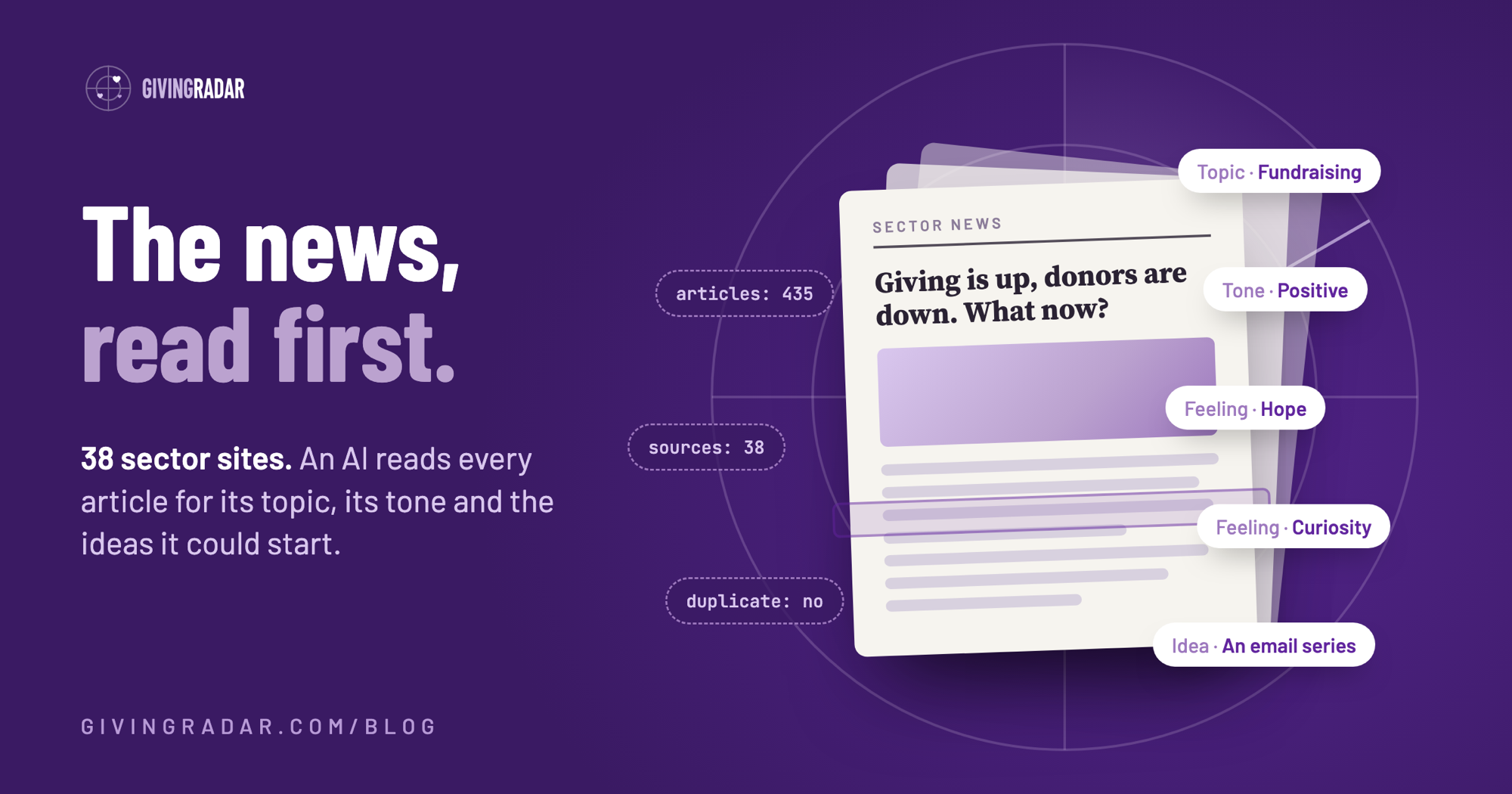
Emails show how nonprofits ask. The news shows what they are hearing while they ask: new research, changes in giving, advice on the next appeal. So next to the email archive, Giving Radar follows 38 news sites and blogs about the sector, from The Chronicle of Philanthropy and Nonprofit Quarterly to fundraising consultants and software companies. That is too much to read closely, so an AI model now reads every article first. This post explains what it does, and what it found in its first 435 articles.
01 - What happens when an article arrives
Every hour the radar checks each site's feed. Then, in order:
- We save the article once. The same story in two feeds, or published again under a new link, is still one article.
- Code finds its main words, the terms that make it different from every other article. This is statistics, not AI, and it's the same method we use for emails.
- An AI model reads it and answers a fixed set of questions (next section).
As with emails, only the last step uses AI.
02 - The questions the AI answers
| Question | Example answers |
|---|---|
| What is it about? | 1 to 3 of 23 topics: fundraising, public policy, housing, animals... |
| What is its tone? | positive, neutral or negative, with a score and a reason |
| How is the story framed? | crisis, success, policy change, advice |
| Who does it speak to? | fundraisers, board members, major donors |
| Which feelings does it lean on? | hope, urgency, curiosity, pride, fear, guilt... |
| What does it ask the reader to do? | download a report, register for a webinar, or nothing |
| Which organizations does it name? | up to five |
| How could a nonprofit use it? | three ideas, each for a channel: email, social, blog, event, ads |
| What could Giving Radar write about it? | three ideas for the blog or Instagram |
The same rules as for emails keep the answers usable. Topics, feelings and channels come from closed lists: anything the model invents outside them is dropped, so articles can be counted and compared. Answers have word limits, which keeps them short and to the point. And the model is told to stick to what the article says, with no invented names or numbers.
03 - What 435 articles show
These numbers come from the first 435 articles, what our 38 sources had in their feeds when we started: half of them published this September, most of the rest earlier this year.
- The sector mostly talks about itself. 68% of articles are about running a nonprofit and 51% about fundraising. Causes like housing, hunger or animals appear in fewer than 5% each. That's partly our choice of sources, which are written for people who work in nonprofits.
- The tone is upbeat. 53% of articles are positive and only 9% negative.
- Hope and curiosity lead. Hope shows up in 64% of articles and curiosity in 52%, often a new study or a "what we learned" post. Urgency follows at 34%. Fear appears in 4% and guilt in 3 articles out of 435.
- Two out of three articles ask for something. 65% end with a call to action: download the report, join the webinar, book a demo. Sector news asks too.
- Email is still the first idea. Asked how a nonprofit could use each article, the AI suggests email a third of the time, ahead of blog posts and social media.
Hope is as common in the news as in the emails, where 61% aim for hope and 7% for fear. The sector's newsletters and its news sound alike.
04 - The AI as an idea machine
The most useful part isn't the counting. For each article the AI suggests three ways a nonprofit could use the story, and three posts we could write about it. A few of its ideas, as it wrote them:
- From a study of animal advocacy: "Analyze how animal charities use research reports to solicit donations."
- From a podcast on ethical storytelling: "Analyze how top nonprofits balance emotional appeals with client dignity."
- From fundraising benchmark data: "Analyze why matching gifts have become mandatory for successful year-end fundraising."
Not every idea is good, and some repeat. But across 435 articles they make a long list of questions we can check against the emails in the archive. That's how these ideas turn into posts: an idea is a question, the archive gives the answer.
05 - Which model we use
News analysis uses a different setup from emails. We go through Eden AI, a service that gives one door to models from many AI companies, so we can switch models from a menu on our admin without changing code. We started with Gemini 3.5 Flash-Lite, a small and fast model from Google.
About one answer in fourteen comes back as broken JSON. We ask once more, which almost always works.
06 - What we haven't done yet
We are honest about the gap: we haven't checked this AI the way we checked the email AI. For emails we labelled 200 by hand and measured how often each model agreed with us. The news labels haven't had that test yet, so for now we treat them as a rough map, not as findings. Tone and feelings are the softest parts; topics are the firmest.
Next:
- Hand-label a sample of articles and compare Gemini with models from OpenAI, Mistral and Anthropic on the same set, as we did for emails.
- Put news next to emails: when the news talks about a crisis, do the fundraising emails follow within days?
As always, the AI reads and labels. People decide what it means and what gets published.