The first ten days of asking
We signed up to 68 nonprofits and read everything they sent. the result is amazing!
· 7 min read
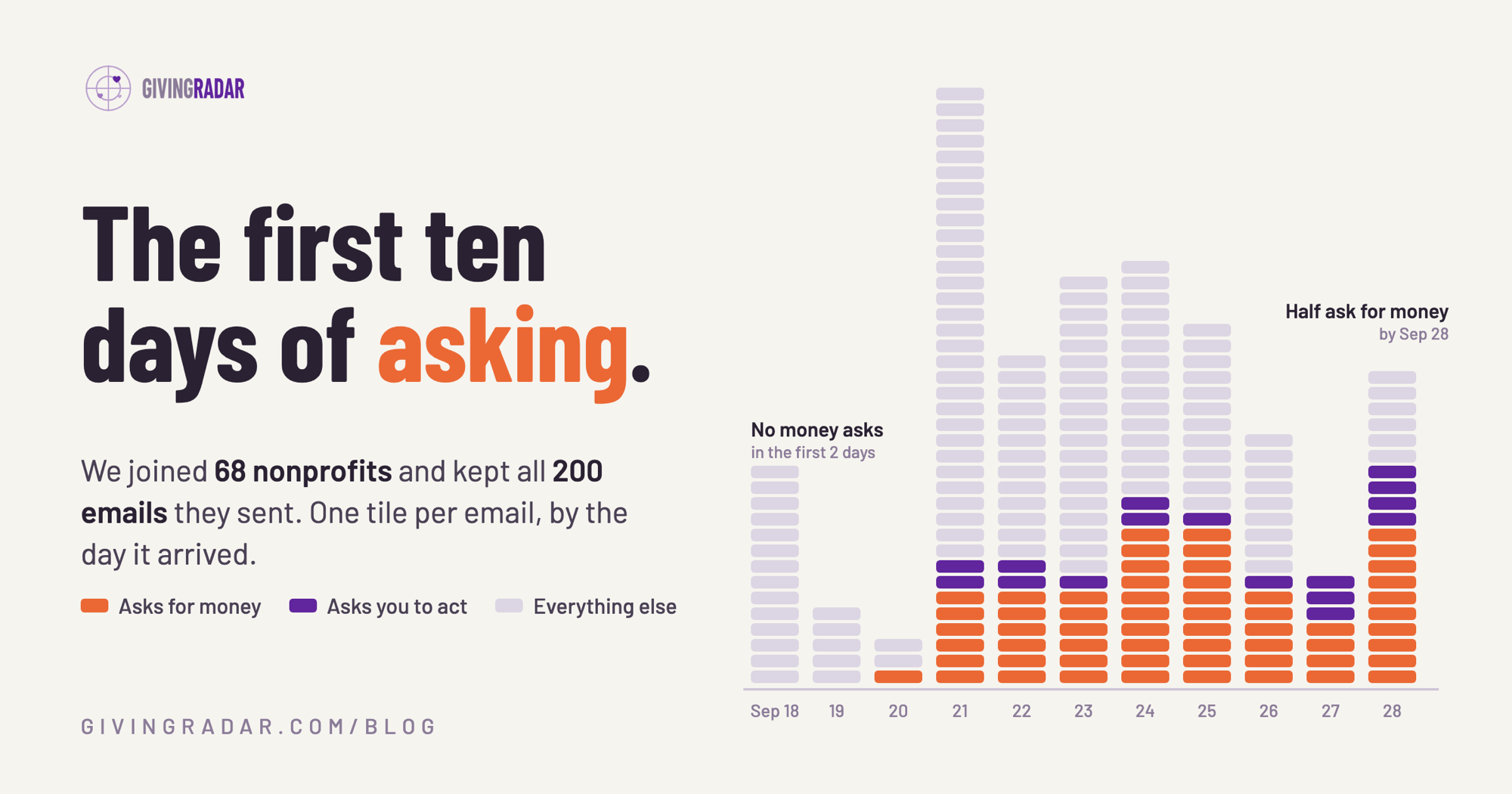
We signed up to 68 nonprofits and read everything they sent: 200 emails. Here is what they ask for, when they ask, how they ask, and a set of categories we can build into the archive.
What we are seeing?
200 emails 68 organizations 8 causes
00 - Your six questions, answered
These were the starting questions. Some turned out to be the wrong question, and the note under each one says why.
01 - Nearly every email has a donate link. Few are really about money.
Three out of four emails carry a Donate link, usually in the header or footer. But when you ask what the email mainly wants you to do, money is the answer only about a third of the time. The most common ask is "watch or read something", followed by donating once and then by surveys and quizzes.
So "is it asking for a donation?" is almost always yes and tells us little. "What is the one thing it wants?" separates the emails.
Main ask, one per email (200 emails). Orange = money, purple = political or civic action.
02 - A welcome series has a shape: thanks, get to know you, then ask
Because we joined every list in the same ten days, the collection is mostly welcome series. Lining up each organization's emails in the order they arrived shows the same pattern at most of them. The first email says thank you. The second tells a story or asks you to fill in a survey. By the third, appeals are the largest single type.
Stage of each email by its position in that organization's sequence. Position 1 is the first email we received from them.
Timing varies a lot. 38 of the 68 organizations have already asked for money as the main point of an email. Half of those did it within about a day of signup, and 15 did it in the very first email: Habitat sent a "final week for a 2X match" appeal the same day as its welcome. The other 30 have not asked yet. They are warming up with stories, resources and surveys.
03 - The survey is the new first ask
25 emails have a survey or quiz as their main ask, more than any money ask except a one-time gift. Some are real surveys (ACLU, UNCF, Easterseals, The Nature Conservancy). Some are built into the email itself (Michael J. Fox, Blood Cancer United). Some are quizzes that turn into a gift: UNICEF's quiz "unlocks" a $2 donation, and Partners In Health's quiz answer is always "All of the above". They sort new subscribers and get a first click before the money ask. Easterseals put a midnight deadline on its survey, between two Donate Now buttons.
04 - Tactics: stories, social proof and flattery beat the countdown clock
Matches and deadlines are the obvious fundraising devices, but the softer ones show up more often. An email can use several.
Emails using each tactic (200 emails; one email can use several).
Month-end pressure is real. Matches came in 1X, 2X, 3X, 4X and 5X sizes, and they cluster around September 30: charity: water's match, UNCF's $25,000 goal "by midnight Sept. 30", Prosper Global's "final hours" at 3X, NRDC's 4X on monthly gifts only.
DAF Day (October 8) is already running. 14 emails lean on tax-advantaged giving, and donor-advised funds are the main vehicle. IRC ran a DAF webinar and a 5X match through DAF Day, Komen and Food For The Poor pushed it, and MAP International sent a DAF-only appeal from its CEO.
Premiums are sold as recurring gifts. Audubon (a "free" magazine with an annual gift that renews itself), WWF (a magazine with $10 a month), Alzheimer's Association (a purple journal for $25), Komen (a $39 tee).
Each cause has its own playbook
Most common main ask and top tactics by cause (the organization's vertical in the organizations collection).
Environmental groups lead with crisis and petitions (NRDC, Sierra Club, Audubon) and are the ones selling magazine premiums. International development groups tell named-beneficiary stories. Animal groups flatter ("you're already a hero"). Humanitarian groups use the most faith language.
05 - A person's name on the email means more pressure
69 emails come from a named person ("Heidi S, International Rescue Committee", "Karen Barr, No Kid Hungry", a CEO) rather than from the organization. They are not more likely to be appeals. But they use nearly twice as many tactics per email, because the letter format carries the story, the flattery and the "I'm asking you personally".
06 - Simple or complex HTML is a scale, and length follows it
Almost nobody sends truly simple HTML. The typical email has 25 layout tables, 9 images and about 100 inline styles, and two thirds include Outlook-specific markup. We sorted them into three looks using measured features: images, tables and number of links.
Plain letter: 3 or fewer images and 12 or fewer tables. Designed newsletter: 8 or more links or 14 or more images. Everything else is a branded letter.
Plain letters are mostly system emails (confirmations) and a few "personal" appeals. The branded letter, with a logo, a hero image, text and one button, is the sector's default. Designed newsletters are longer (about 420 words) and spread attention across many links.
07 - One in ten emails shipped with a visible mistake
We found more than 20 emails with errors a reader would notice:
- Unfilled template code: March of Dimes shows
${CTAText2}in four emails. International Medical Corps shows raw{campaignpage_url~…}tags, and Plan International exposes a "FY23 LEADS JOURNEY" code. - Drafts sent to subscribers: International Medical Corps sent a welcome whose whole body is "Re-do this email from the old one", twice. Conservation International left "[VIDEO HERE]" in a letter signed by an executive.
- Wrong audience: Guide Dogs for the Blind told a new subscriber they are a puppy-raising volunteer. Alley Cat Allies' welcome includes tax-receipt wording, though no gift was made.
- Duplicates: Direct Relief, Food For The Poor, City Harvest and Samaritan's Purse each sent the same email two or three times.
This could become a blog series of its own.
08 - The categories we should build
Based on what separated the emails in practice, here is the set I recommend storing for every email. Claude labels the first five from the text. Rules compute the rest for free.
| Field | Values | Source |
|---|---|---|
| Stage | confirm · welcome · nurture · appeal · newsletter · action alert · event · survey · commerce | Claude |
| Main ask | donate once · monthly · DAF · sponsor · act · survey/quiz · watch/read · buy · attend · volunteer · confirm · none | Claude |
| Tactics | match · deadline · named story · premium · social proof · urgency/crisis · personal letter · ask amount · gamification · faith · guilt · tax benefit · exclusivity · flattery | Claude |
| Voice | organization · staff · CEO · celebrity · beneficiary | Claude (the From line helps) |
| Calendar hook and topic | free text, e.g. "DAF Day Oct 8", "Gaza hunger" | Claude |
| Problems | merge tag · placeholder · duplicate · wrong audience | rules (regex), with Claude's note |
| Design | plain letter · branded letter · designed newsletter, plus the counts | rules on the HTML |
| Donate link present | yes / no | rules on the calls to action already stored |
| Position in sequence | email #N from this organization, days since the first | computed |
I dropped "is it sharing news?" as its own question: news shows up as the newsletter stage or the urgency/crisis tactic. "Is it an organizational campaign?" is split into action alert, calendar hook and match/deadline, because those are different kinds of campaign.
09 - Every email
Search Stage Ask Tactic
10 - How this was done, and its limits
- Every visible email in the archive from 18 to 28 September (200 nonprofit emails plus one Google Cloud email, which was excluded). Nothing in the database was changed.
- Claude read each email's text and calls to action and labelled it against one fixed list of categories. Four readers did about 50 emails each. Design, email tool and sequence position were measured with rules.
- Text was cut at 3,000 characters, and about 20 emails only have HTML or a stub as text, so for those the labels lean on the subject and buttons.
- "Position in sequence" counts from the first email we received from each organization, not the exact signup time.
- Ten days of welcome series is not a normal month of email. The share of appeals will rise as these lists settle into their regular schedule.